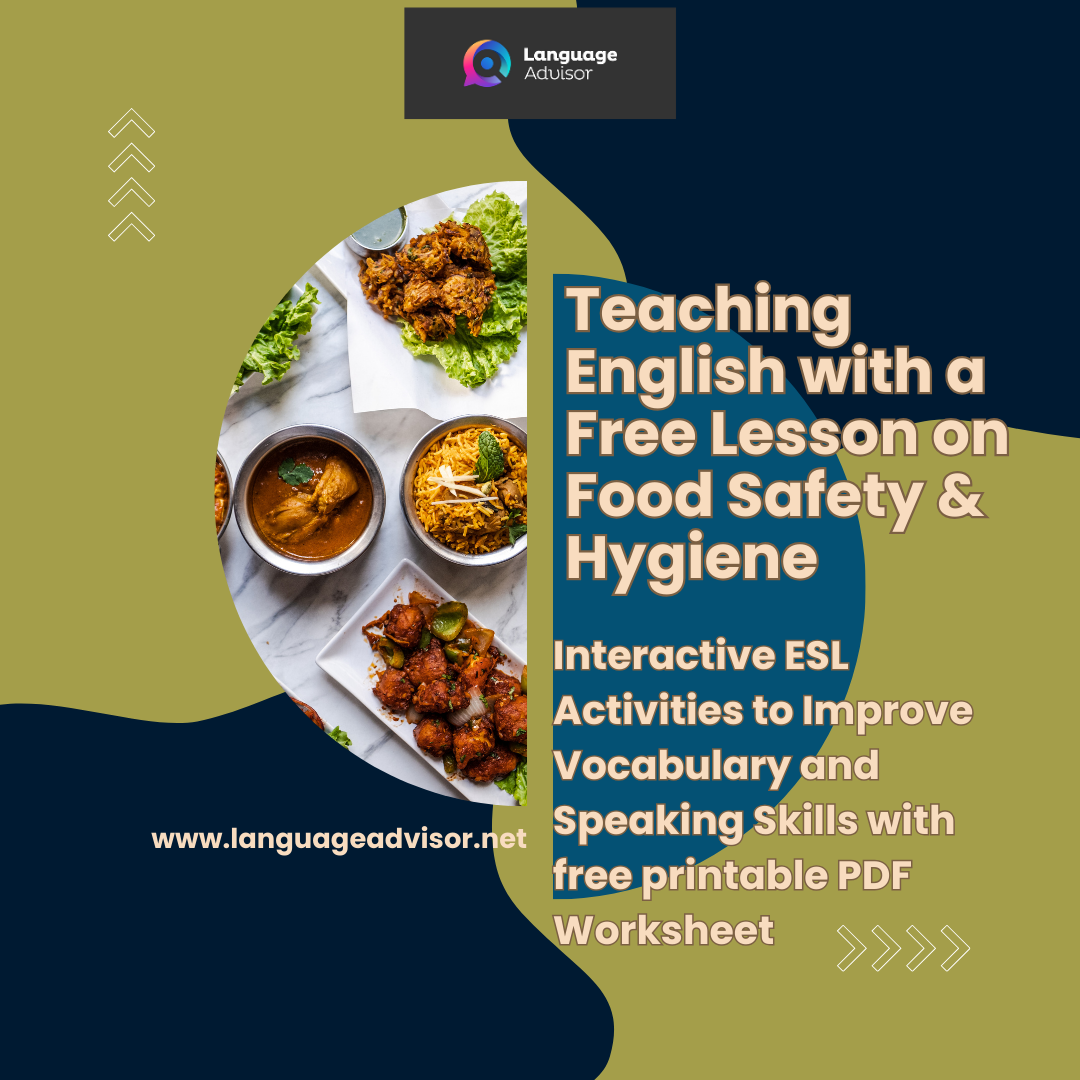
Teaching English with a Free Lesson on Food Safety & Hygiene: Interactive ESL Activities to Improve Vocabulary and Speaking Skills with free printable PDF Worksheet
Teaching English with a Free Lesson on Food Safety & Hygiene

Teaching English with a Free Lesson on Food Safety & Hygiene
Looking for a free and engaging ESL lesson plan on food safety and hygiene? This ready-to-use English lesson helps students develop their vocabulary, improve fluency, and discuss household responsibilities and food hygiene while practicing modal verbs and the present tense.
Why Teach a Lesson on Food Safety?
Food safety is a practical and relatable topic that helps ESL learners discuss daily habits and responsibilities. This lesson will help students:
✅ Improve speaking skills through discussion-based activities
✅ Learn important food hygiene vocabulary
✅ Understand food safety best practices
✅ Practice modal verbs (must, should, have to) in real-life contexts
Lesson Plan: Food Safety and Hygiene
Objective
To encourage students to talk about food safety, hygiene, housework habits, and pet hates, while practicing key vocabulary and grammar structures.
Materials
📄 Calamity Kitchen Worksheet
📄 Food Safety Quiz
Warm-Up: Discussion on Food Poisoning
👩🏫 Start by telling students that “Food Safety Week” took place in the UK from June 10–16.
🇬🇧 Did you know?
📊 Every year, 4.5 million people in the UK suffer from food poisoning!
Ask students:
- What do you know about food safety?
- Have you or someone you know ever had food poisoning?
- Was it from home-cooked food or a restaurant?
Encourage personal stories to get students speaking!
Activity 1: Calamity Kitchen (Spot the Food Hazards!)
👀 Task:
Students work in pairs to identify potential hazards in a messy kitchen scene.
📌 Key Food Safety Issues:
✔ Fridge door ajar → Keep the fridge temperature between 0°C and 5°C.
✔ Raw fish on chopping board → Use separate boards for raw and cooked foods.
✔ Uncooked chicken left uncovered → Store raw foods on the bottom shelf of the fridge.
✔ Dirty tea towels → Use separate towels for different tasks.
✔ Pets near food areas → Keep pets away from food prep surfaces.
📝 Write new vocabulary on the board as students discuss.
Activity 2: Food Safety Quiz (Test Your Knowledge!)
📝 Do this multiple-choice quiz with students to reinforce learning.
Sample Questions:
1️⃣ How do you know when burgers are properly cooked?
a) When they are brown on the outside
b) When there are no pink bits inside and the juices run clear ✅
c) After cooking for 7 minutes
2️⃣ What temperature should a fridge operate at?
a) Below 0°C
b) 0 to 5°C ✅
c) 5 to 10°C
3️⃣ What’s the correct way to thaw frozen chicken?
a) Leave in a warm room
b) Put in hot water
c) Place in the fridge ✅
🗣️ Encourage discussion! After each question, ask students why they chose their answers.
Discussion Questions (Household Habits & Hygiene)
Use these questions to encourage fluency and deeper conversations:
1️⃣ Who normally does the housework in your home?
2️⃣ Do you have a household chore you absolutely hate? Why?
3️⃣ What is the best invention for making housework easier?
4️⃣ What household inventions would you like to see in the future?
💬 Encourage students to use modal verbs (must, should, have to, need to) in their answers.
Useful Vocabulary for Food Safety & Hygiene
🛑 Food Safety Terms
- Cross-contamination – when bacteria spread between foods
- Expiration date – the date after which food is no longer safe to eat
- Perishable foods – foods that spoil quickly (e.g., milk, meat)
- Bacteria growth – when harmful microorganisms multiply in food
- Foodborne illness – sickness caused by contaminated food
🧹 Housework & Hygiene Vocabulary
- To wipe down (e.g., “I wipe down the counters every night.”)
- To disinfect (e.g., “You should disinfect kitchen surfaces regularly.”)
- To wash up (e.g., “Don’t forget to wash up the dishes!”)
- To store properly (e.g., “Leftovers should be stored properly in the fridge.”)
Proverbs & Sayings About Cleanliness
💡 “Cleanliness is next to godliness.” – Being clean is important.
💡 “A place for everything and everything in its place.” – Keep things organized!
💡 “Better safe than sorry.” – It’s better to be careful than risk danger.
Final Activity: Role-Play on Food Hygiene
🗣 Scenario-Based Speaking Practice
- Situation: You are opening a small restaurant, but your kitchen is not following food safety rules.
- Task: One student plays the restaurant owner, and another is the health inspector.
- The inspector gives recommendations using modal verbs (“You must clean the fridge.” / “You should store eggs properly.”).
- The restaurant owner must respond and discuss solutions.
🎭 Switch roles so all students practice giving advice!
Conclusion
This food safety-themed ESL lesson helps students:
✅ Expand hygiene and housework vocabulary
✅ Practice modal verbs in real-life situations
✅ Improve fluency through discussion and role-playslife conversation practice.
📩 Want more free ESL lesson plans? Share this post with other teachers and let us know how it worked in your classroom!
💬 What other topics would you like lesson plans on? Drop your ideas in the comments!
DOWNLOAD THE PDF FOR FREE