
Movers Cambridge Speaking test. It is a very friendly exam, with colorful pictures, cards and they are all activity-based. Free PDF
Movers Cambridge Speaking test
Movers Cambridge Speaking test
The A1 Movers Speaking Exam has four parts. All parts are carried out by a Speaking Examiner who will be sitting right next to the child.
It is a very friendly exam, with colorful pictures, cards and they are all activity-based. Here is an overview task table:

The Speaking Exam for A1 learners takes from 5-7 minutes. Children are assessed by their knowledge related to vocabulary, pronunciation, and interaction. They can get a total of 15 marksfor this exam, which grants them up to 5 shields.
For this exam, an usher introduces the child to the examiner, then he/she leaves the room. The children take this exam by themselves.
Part 1: Two Similar Pictures
The examiner greets the candidate telling his/her own name and asks the candidate’s name and age. This part is unassessed. Then, the examiner starts the test by demonstrating what is required.
The examiner shows two colorful pictures that look similar but have some differences and describes them, modeling the first answer by saying and pointing, e.g. “Look at these pictures. They look the same, but some things are different. In this picture it is sunny, but in this picture it’s cloudy. What other different things can you see?“. With this question, the examiner expects that the candidate points out four differences.
This part of the test tests children’s ability to describe differences between pictures, like talking about color, size, number, position, how people/things look, what people are doing, etc. Here is a sample:

Part 2: Picture Sequence (telling a story)
The examiner removes the pictures from the previous task and shows the candidate a sequence of four colorful pictures which tell a story. Then he/she says “These pictures show a story, it’s called ‘Fred Loves Food’. Look at the pictures first“. At this point, the examiner gives the student a couple of seconds so that he/she gets familiarized with the scene. After a while, he/she points to the first picture and start the story, modeling: “Fred’s at home with his family. They’re in the kitchen and Mum’s giving him his dinner. Now you tell the story” and offers the candidate a chance to continue the story.
This part of the test requires candidates to look at the pictures to get a general idea of the story before they start describing things and events. Children should not worry if they cannot follow the narrative of the picture story. It is perfectly acceptable just to say a few words about each picture in the sequence. Here is a sample:

Part 3: Picture Sets (Which is different?)
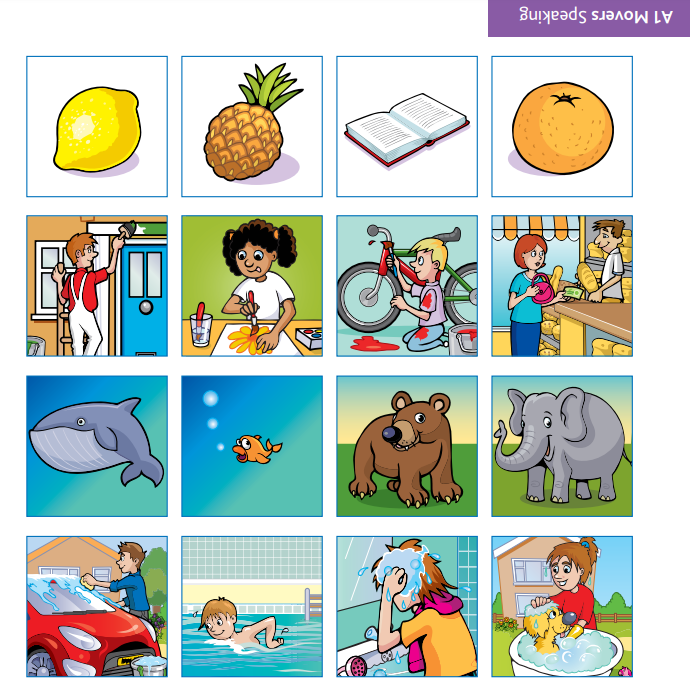
The examiner removes the pictures from the previous task and shows the candidate a set of 4 colorful pictures where one picture in each set is the ‘odd one out’. Then he/she says, “look at these four pictures. One is different. The book is different. A lemon, a pineapple, and an orange are fruit. You eat them. You don’t eat a book. You read it. Now, you tell me about these pictures. Which one is different?“.
This part of the test requires candidates to identify which picture is the odd one out in the remaining three sets and say why. Here is a sample:
Part 4: Personal Questions
The examiner removes the pictures from the previous task and starts asking some personal questions on topics such as school, weekends, friends, and hobbies. For example, “Let’s now talk about parties. What do you eat at parties?“
This part of the test tests children’s understanding and responding to personal questions.
All downloads are in PDF format



I NEED SOME PICTURE OF MOVERS SPEAKING, YOU CAN GIVE ME SOME PICTURE ?
You can find many pictures on the website. Just use the search button