
Untangling Truth: Navigating the Landscape of Logical Fallacies: Ad Hominem Fallacies. Free PowerPoint and Videos
Untangling Truth: Navigating the Landscape of Logical Fallacies: Ad Hominem Fallacies

Untangling Truth: Navigating the Landscape of Logical Fallacies: Ad Hominem Fallacies
What are logical fallacies?
Logical fallacies are like landmines; easy to overlook until you find them the hard way.
One of the most important components of learning in college is academic discourse, which requires argumentation and debate. Argumentation and debate inevitably lend themselves to flawed reasoning and rhetorical errors. Many of these errors are considered logical fallacies. Logical fallacies are commonplace in the classroom, in formal televised debates, and perhaps most rampantly, on any number of internet forums.
But what is a logical fallacy? And just as important, how can you avoid making logical fallacies yourself? Whether you’re in college, or preparing to go to college; whether you’re on campus or in an online bachelor’s degree program, it pays to know your logical fallacies. This article lays out some of the most common logical fallacies you might encounter, and that you should be aware of in your own discourse and debate.
A logical fallacy is an error in reasoning common enough to warrant a fancy name. Knowing how to spot and identify fallacies is a priceless skill. It can save you time, money, and personal dignity. There are two major categories of logical fallacies, which in turn break down into a wide range of types of fallacies, each with their own unique ways of trying to trick you into agreement.
A Formal Fallacy
A breakdown in how you say something. The ideas are somehow sequenced incorrectly. Their form is wrong, rendering the argument as noise and nonsense.
An Informal Fallacy
Denotes an error in what you are saying, that is, the content of your argument. The ideas might be arranged correctly, but something you said isn’t quite right. The content is wrong or off-kilter.
Ad Hominem Fallacy

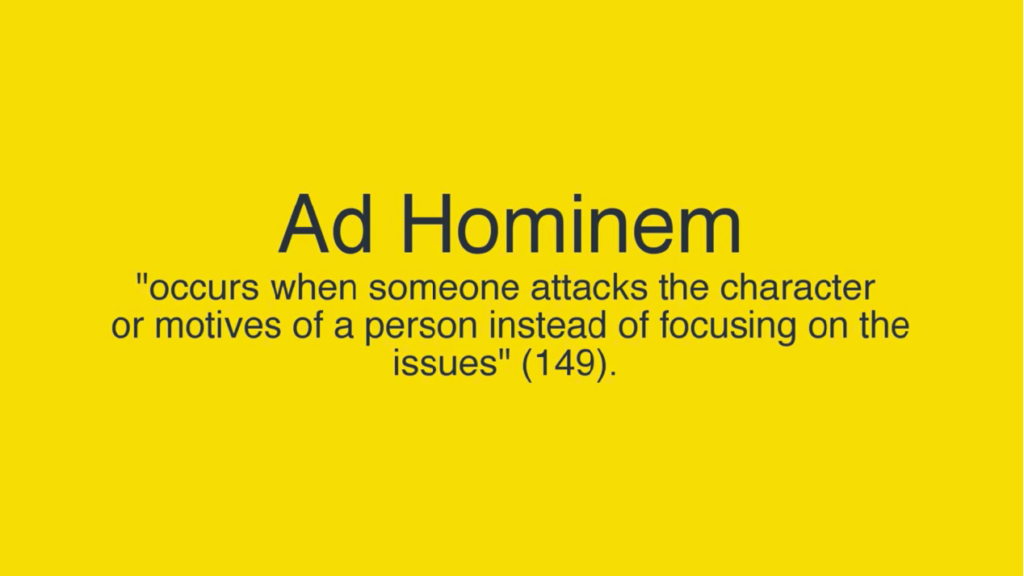
When people think of “arguments,” often their first thought is of shouting matches riddled with personal attacks. Ironically, personal attacks run contrary to rational arguments. In logic and rhetoric, a personal attack is called an ad hominem. Ad hominem is Latin for “against the man.” Instead of advancing good sound reasoning, an ad hominem replaces logical argumentation with attack-language unrelated to the truth of the matter.
More specifically, the ad hominem is a fallacy of relevance where someone rejects or criticizes another person’s view on the basis of personal characteristics, background, physical appearance, or other features irrelevant to the argument at issue.
An ad hominem is more than just an insult. It’s an insult used as if it were an argument or evidence in support of a conclusion. Verbally attacking people proves nothing about the truth or falsity of their claims. Use of an ad hominem is commonly known in politics as “mudslinging.”
Instead of addressing the candidate’s stance on the issues, or addressing his or her effectiveness as a statesman or stateswoman, an ad hominem focuses on personality issues, speech patterns, wardrobe, style, and other things that affect popularity but have no bearing on their competence. In this way, an ad hominem can be unethical, seeking to manipulate voters by appealing to irrelevant foibles and name-calling instead of addressing core issues. In this last election cycle, personal attacks were volleyed freely from all sides of the political aisle, with both Clinton and Trump facing their fair share of ad hominem fallacies.
Ad hominem is an insult used as if it were an argument or evidence in support of a conclusion.
A thread on Quora lists the following doozies against Hillary Clinton: “Killary Clinton,” “Crooked Hillary,” “Hilla the Hun,” “Shillary,” “Hitlery,” “Klinton,” “Hildebeest,” “Mr. President,” “Heil Hillary,” “Wicked Witch of the West Wing,” “Robberty Hillham Clinton,” and the decidedly unsubtle, “The Devil.”
The NY Daily News offers an amusing list of insults against Donald Trump: “Short fingered Vulgarian,” “Angry Creamsicle,” “Fascist Carnival Barker,” “F*ckface von Clownstick,” “Decomposing Jack-O-Lantern,” “Chairman of the Saddam Hussein Fanclub,” “Racist Clementine,” “Sentient Caps Lock Button,” “Cheeto Jesus,” “Tangerine Tornado,” and perhaps the most creative/literary reference, “Rome Burning in Man Form.”
The use of ad hominem often signals the point at which a civil disagreement has descended into a “fight.” Whether it’s siblings or friends, most everyone has had a verbal disagreement crumble into a disjointed shouting match of angry insults and accusations aimed at discrediting the other person. When these insults crowd out a substantial argument, they become ad hominems.
Untangling Truth: Navigating the Landscape of Logical Fallacies: Ad Hominem Fallacies
DOWNLOAD THE POWER POINT FOR FREE
Logical Fallacies
Also check out these free resources on Critical Thinking and Logical Fallacies


Related posts:
 Navigating the Maze: Unraveling Logical Fallacies and Exposing the Strawman Argument
 Decoding Reasoning: Exploring Logical Fallacies and the Pitfalls of Appeal to Ignorance
 Navigating the Mind: Unraveling the Threads of Critical Thinking and Cognitive Bias – Posters and Cards
 Beyond the Illusion: Navigating Critical Thinking Through the Shadows of Placebo Bias