
Slipping through Reason: An Exploration of Logical Fallacies and the Pitfalls of Slippery Slope Arguments. Free PowerPoint and Videos
Slipping through Reason: An Exploration of Logical Fallacies and the Pitfalls of Slippery Slope Arguments

Slipping through Reason: An Exploration of Logical Fallacies and the Pitfalls of Slippery Slope Arguments
What are logical fallacies?
Logical fallacies are like landmines; easy to overlook until you find them the hard way.
One of the most important components of learning in college is academic discourse, which requires argumentation and debate. Argumentation and debate inevitably lend themselves to flawed reasoning and rhetorical errors. Many of these errors are considered logical fallacies. Logical fallacies are commonplace in the classroom, in formal televised debates, and perhaps most rampantly, on any number of internet forums.
But what is a logical fallacy? And just as important, how can you avoid making logical fallacies yourself? Whether you’re in college, or preparing to go to college; whether you’re on campus or in an online bachelor’s degree program, it pays to know your logical fallacies. This article lays out some of the most common logical fallacies you might encounter, and that you should be aware of in your own discourse and debate.
A logical fallacy is an error in reasoning common enough to warrant a fancy name. Knowing how to spot and identify fallacies is a priceless skill. It can save you time, money, and personal dignity. There are two major categories of logical fallacies, which in turn break down into a wide range of types of fallacies, each with their own unique ways of trying to trick you into agreement.
A Formal Fallacy
A breakdown in how you say something. The ideas are somehow sequenced incorrectly. Their form is wrong, rendering the argument as noise and nonsense.
An Informal Fallacy
Denotes an error in what you are saying, that is, the content of your argument. The ideas might be arranged correctly, but something you said isn’t quite right. The content is wrong or off-kilter.
Slippery slope fallacy
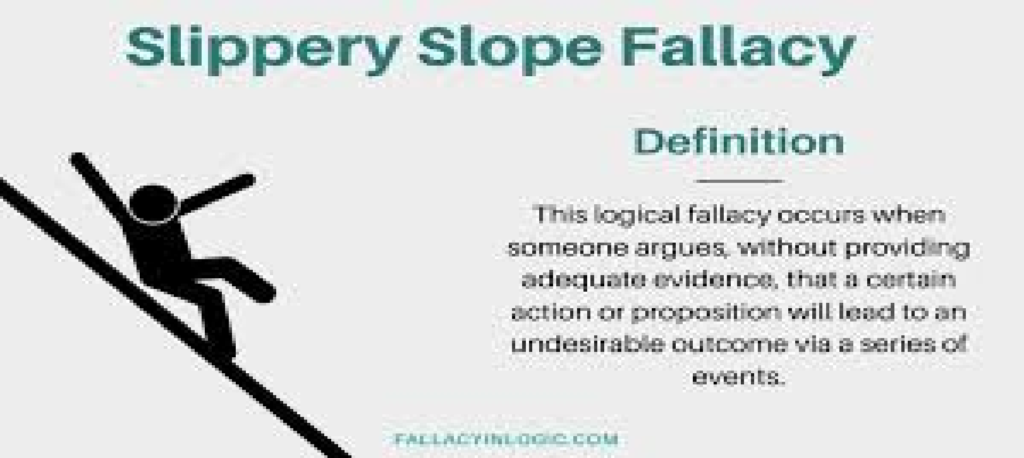
You may have used this fallacy on your parents as a teenager: “But, you have to let me go to the party! If I don’t go to the party, I’ll be a loser with no friends. Next thing you know I’ll end up alone and jobless living in your basement when I’m 30!” The slippery slope fallacy works by moving from a seemingly benign premise or starting point and working through a number of small steps to an improbable extreme.
This fallacy is not just a long series of causes. Some causal chains are perfectly reasonable. There could be a complicated series of causes that are all related, and we have good reason for expecting the first cause to generate the last outcome. The slippery slope fallacy, however, suggests that unlikely or ridiculous outcomes are likely when there is just not enough evidence to think so.
The slippery slope fallacy suggests that unlikely or ridiculous outcomes are likely when there’s just not enough evidence to think so.
It’s hard enough to prove one thing is happening or has happened; it’s even harder to prove a whole series of events will happen. That’s a claim about the future, and we haven’t arrived there yet. We, generally, don’t know the future with that kind of certainty. The slippery slope fallacy slides right over that difficulty by assuming that chain of future events without really proving their likelihood.
Slipping through Reason: An Exploration of Logical Fallacies and the Pitfalls of Slippery Slope Arguments
DOWNLOAD THE POWER POINT FOR FREE
Logical Fallacies
Also check out these free resources on Critical Thinking and Logical Fallacies







Related posts:
 Decoding Reasoning: Exploring Logical Fallacies and the Pitfalls of Appeal to Ignorance
 Dismantling Deceptive Arguments: Unveiling Logical Fallacies and Confronting the False Dilemma
 Untangling Truth: Navigating the Landscape of Logical Fallacies: Ad Hominem Fallacies
 Navigating the Maze: Unraveling Logical Fallacies and Exposing the Strawman Argument