
Lost in the Scent: Unmasking Logical Fallacies and Tracing the Elusive Red Herring. Free PowerPoint and Videos
Lost in the Scent: Unmasking Logical Fallacies and Tracing the Elusive Red Herring

Lost in the Scent: Unmasking Logical Fallacies and Tracing the Elusive Red Herring
What are logical fallacies?
Logical fallacies are like landmines; easy to overlook until you find them the hard way.
One of the most important components of learning in college is academic discourse, which requires argumentation and debate. Argumentation and debate inevitably lend themselves to flawed reasoning and rhetorical errors. Many of these errors are considered logical fallacies. Logical fallacies are commonplace in the classroom, in formal televised debates, and perhaps most rampantly, on any number of internet forums.
But what is a logical fallacy? And just as important, how can you avoid making logical fallacies yourself? Whether you’re in college, or preparing to go to college; whether you’re on campus or in an online bachelor’s degree program, it pays to know your logical fallacies. This article lays out some of the most common logical fallacies you might encounter, and that you should be aware of in your own discourse and debate.
A logical fallacy is an error in reasoning common enough to warrant a fancy name. Knowing how to spot and identify fallacies is a priceless skill. It can save you time, money, and personal dignity. There are two major categories of logical fallacies, which in turn break down into a wide range of types of fallacies, each with their own unique ways of trying to trick you into agreement.
A Formal Fallacy
A breakdown in how you say something. The ideas are somehow sequenced incorrectly. Their form is wrong, rendering the argument as noise and nonsense.
An Informal Fallacy
Denotes an error in what you are saying, that is, the content of your argument. The ideas might be arranged correctly, but something you said isn’t quite right. The content is wrong or off-kilter.
Red Herring Fallacy (ignoratio elenchi)

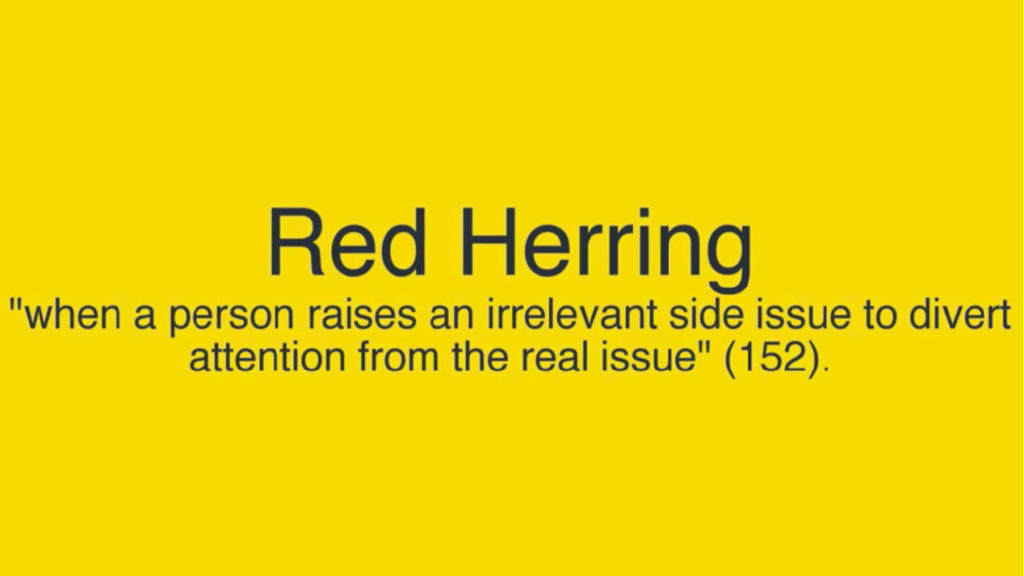
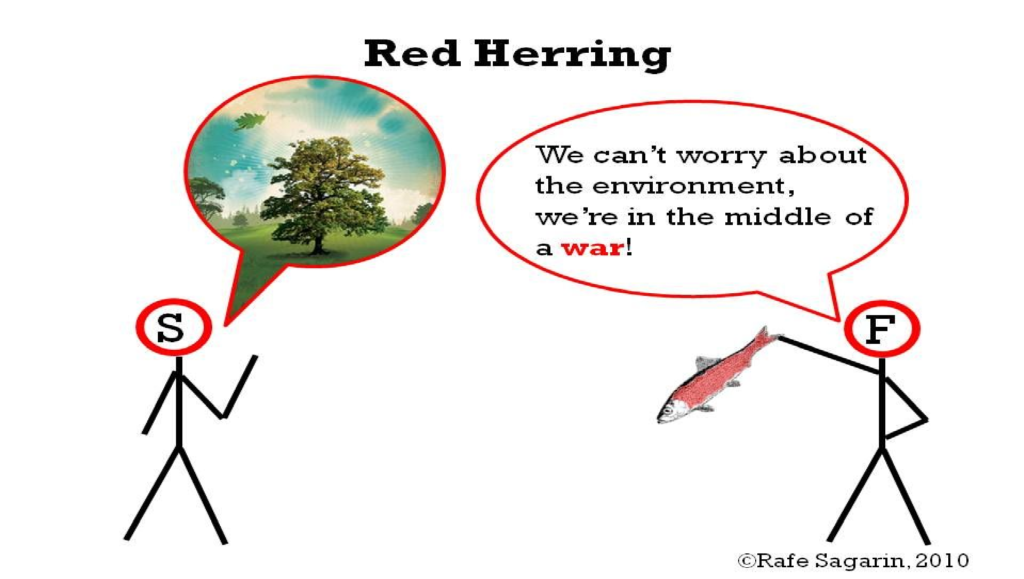
A “red herring fallacy” is a distraction from the argument typically with some sentiment that seems to be relevant but isn’t really on-topic. This tactic is common when someone doesn’t like the current topic and wants to detour into something else instead, something easier or safer to address. A red herring fallacy is typically related to the issue in question but isn’t quite relevant enough to be helpful. Instead of clarifying and focusing, it confuses and distracts.
A red herring fallacy can be difficult to identify because it’s not always clear how different topics relate.
The phrase “red herring” refers to a kippered herring (salted herring-fish) which was reddish brown in color and quite pungent. According to legend, this aroma was so strong and delectable to dogs that it served as a good training device for testing how well a hunting dog could track a scent without getting distracted. Dogs aren’t generally used for hunting fish so a red herring is a distraction from what he is supposed to be hunting.
A red herring fallacy can be difficult to identify because it’s not always clear how different topics relate. A “side” topic may be used in a relevant way, or in an irrelevant way. In the big meaty disagreements of our day, there are usually a lot of layers involved, with different subtopics weaving into them. We can guard against the red herring fallacy by clarifying how our part of the conversation is relevant to the core topic.
Lost in the Scent: Unmasking Logical Fallacies and Tracing the Elusive Red Herring
DOWNLOAD THE POWER POINT FOR FREE
Logical Fallacies
Also check out these free resources on Critical Thinking and Logical Fallacies






Related posts:
 Untangling Truth: Navigating the Landscape of Logical Fallacies: Ad Hominem Fallacies
 Decoding Reasoning: Exploring Logical Fallacies and the Pitfalls of Appeal to Ignorance
 Circling Logic: Unraveling Logical Fallacies and Exposing the Circular Reasoning Fallacy
 Hasty Conclusions: Navigating Logical Fallacies and Unraveling the Pitfalls of Hasty Generalization